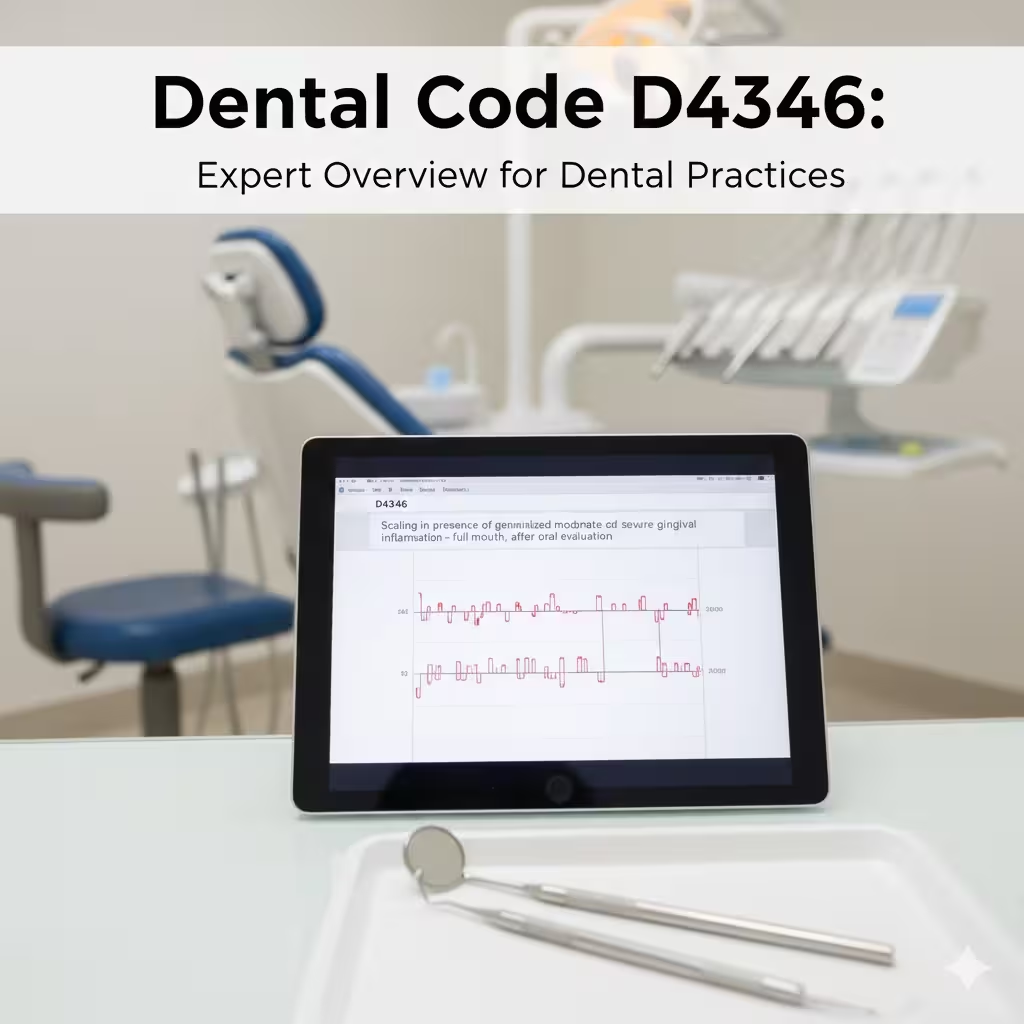
The D4346 dental code exists for a common clinical scenario many dental teams face: patients with generalized moderate to severe gingival inflammation who need therapeutic full mouth scaling, but don’t meet the criteria for scaling and root planing (SRP).
When D4346 is coded and documented correctly, it protects your diagnosis, supports accurate insurance billing, and helps reduce the avoidable denials that slow down cash flow and frustrate patients.
If you’re considering a dental billing company in USA to reduce denials and protect collections, D4346 is one of the first places where experts follow through and can make a visible impact.
Here you will find a practical, payer aware explanation of what D4346 means, when it is appropriate, what documentation makes it defensible, and how to submit claims that are easier to approve and easier to explain to patients.
What Is The D4346 Dental Code And What Does It Actually Cover?
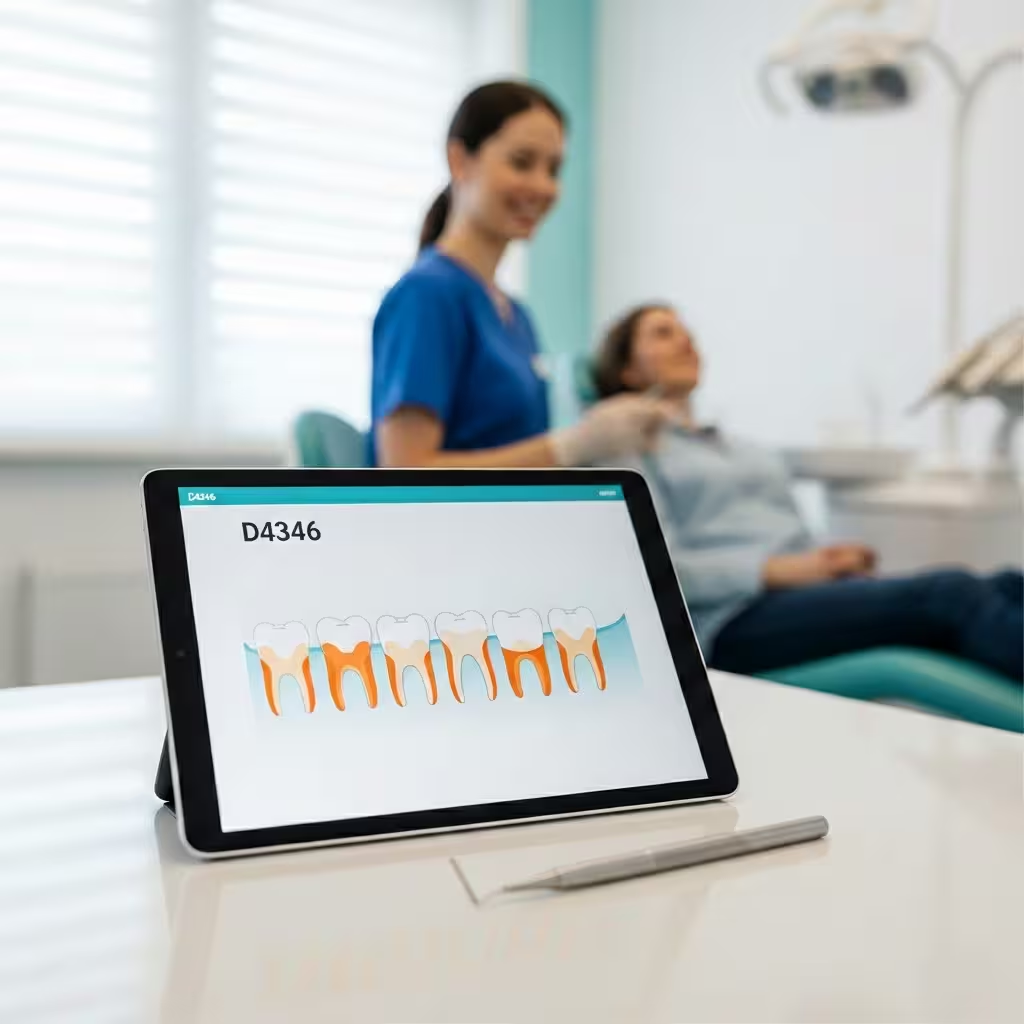
CDT code D4346 is defined as: “Scaling in presence of generalized moderate or severe gingival inflammation – full mouth, after oral evaluation.” It describes removal of plaque, calculus, and stains from supra and subgingival tooth surfaces when there is generalized moderate to severe gingival inflammation in the absence of periodontitis.
What that means for a dental office:
- This is therapeutic care. You are treating active inflammation, not providing routine preventive maintenance.
- It is a full mouth service. It is not billed by quadrant.
- It is performed after an oral evaluation, with a diagnosis that supports gingivitis with generalized moderate to severe inflammation.
- It is intended to fill the coding gap between a routine prophylaxis and SRP.
For practices using outsourced dental billing, D4346 is a strong reminder that the code, diagnosis, and documentation must tell the same story.
D4346 exists because “difficult prophy” is not a diagnosis, and time alone is not enough to justify a different code.
When Is D4346 The Right Choice For A Patient In Your Chair?
For dental teams, the most practical way to decide is to ask two questions:
- Is inflammation generalized and moderate to severe?
- Is there attachment loss or bone loss that would make SRP the correct choice instead?
D4346 is appropriate when you have a patient with:
- Generalized moderate to severe gingival inflammation (not just a localized area)
- Often, moderate to severe bleeding on probing
- Pseudopocketing or suprabony pocketing can be present
- No attachment loss and no bone loss consistent with periodontitis
- A need for full mouth scaling to remove irritants and promote healing
Many practices use a “generalized” threshold concept of 30% or more of teeth involved as a helpful anchor in documentation and conversations, especially when tied to bleeding points and inflammation distribution.
How Is D4346 Different From D1110 (Prophy) In A Way Insurance Will Accept?
Payers deny D4346 quickly when it looks like a prophy claim with a different code. Your job is to make the difference unmistakable.
A clean payer friendly distinction:
- D1110 (Prophy) is preventive and generally supports healthy periodontium or mild/localized gingivitis.
- D4346 is therapeutic and supports generalized moderate to severe gingival inflammation, with documentation showing why a routine preventive cleaning is not enough.
A common pitfall is writing notes like: “heavy plaque and calculus, prophy completed.”
That language reads preventive, not therapeutic. For D4346, your notes should speak to inflammation severity, distribution, and clinical indicators, not just deposits.
How Is D4346 Different From SRP (D4341/D4342) And Why Does That Matter For Denials?
SRP codes (D4341 and D4342) apply when you have periodontitis with bone loss and subsequent attachment loss, and the procedure includes instrumentation of exposed root surfaces.
D4346, on the other hand, is for generalized moderate to severe gingival inflammation without attachment loss and without bone loss.
Why the distinction matters operationally:
- If your charting or radiographs suggest bone loss, and you submit D4346, the claim may be denied as inconsistent.
- If you submit SRP without appropriate evidence of periodontitis, you risk denials and compliance concerns.
- If you code SRP in one quadrant and want to code D4346 for the rest of the mouth on the same date, ADA guidance indicates D4346 should not be reported in conjunction with SRP, and reimbursement is not guaranteed even with a narrative.
Your best defense is alignment: diagnosis, charting, radiographs, and code all match.
What Clinical Findings Should Your Team Document To Support D4346?
Think of this as “prove generalized gingivitis severity without perio breakdown.”
Strong supportive findings include:
- Periodontal charting that documents pocketing (including pseudopockets) and bleeding on probing
- Clinical notes describing generalized inflammation and severity (moderate to severe)
- Notes supporting no clinical attachment loss
- Radiographs supporting no bone loss consistent with periodontitis (type and frequency per dentist judgment)
- Photos when helpful, especially if your payer regularly challenges D4346
Competitors often mention “4 mm or less” as a common pattern, but the more important point is what ADA emphasizes: pocketing can be present without attachment loss, and your charting should make that clear.
What Documentation Checklist Helps Prevent D4346 Claim Denials?
Here is a tight D4346 “denial prevention” checklist you can turn into an internal SOP:
- Oral evaluation completed and documented (periodic, comprehensive, or periodontal evaluation as appropriate)
- Diagnosis documented in the clinical note (generalized moderate to severe gingival inflammation, no periodontitis)
- Perio charting with pocket depths and BOP
- Radiographs that support absence of bone loss, and are recent enough to support the claim
- Narrative describing:
- generalized inflammation
- bleeding on probing pattern
- absence of attachment loss and bone loss
- why full mouth scaling was medically necessary
- Optional but strong:
- intraoral photos
- gingival condition description consistent with moderate to severe inflammation
This is the difference between “we did the right thing” and “the claim proves we did the right thing.”
Can You Bill D4346 On The Same Day As An Exam?
Yes. ADA guidance notes that D4346 is delivered after an oral evaluation, and there is no exclusionary language that prevents reporting an evaluation and D4346 on the same date of service when clinically appropriate.
What helps reduce pushback:
- Document the evaluation clearly (findings, diagnosis, treatment plan decision).
- Make your narrative consistent with the exam findings and perio chart.
- If your payer has a habit of denying same day services, consider attaching the narrative up front.
Operational tip competitors rarely spell out: make sure the exam note and hygiene note agree on the diagnosis language. If one says “prophy” and the other says “generalized moderate inflammation,” you have built a denial.
What Codes Should Not Be Submitted With D4346 On The Same Date?
According to ADA guidance, D4346 should not be reported in conjunction with:
- D1110 or D1120 (prophylaxis)
- D4341 or D4342 (SRP)
- D4355 (full mouth debridement)
This matters for billing teams because mixed code sets are one of the fastest routes to denial or downgrade. If the patient’s condition shifts from “cannot evaluate due to heavy deposits” to “diagnosed generalized gingivitis requiring scaling,” you need to pick the correct code for the correct stage, and avoid stacking codes that are described as not reportable together.
How Do You Handle Coverage Uncertainty And Patient Expectations Before Treatment?
This is where owners and office managers feel the pain most: unexpected patient balances lead to hard conversations, lower case acceptance, and churn.
A practical approach that protects the patient relationship:
- Verify benefits and ask specifically how the plan processes D4346. Working with the best dental insurance verification company for your payer mix can help you confirm coverage rules upfront and reduce surprise balances.
- If your payer mix frequently denies or downgrades D4346, submit a predetermination when time allows.
- Document that the patient was informed D4346 may be covered differently than a routine cleaning.
- Keep your explanation clinical, not insurance focused: “Your gums are inflamed throughout the mouth, so this is a therapeutic scaling, not a routine preventive cleaning.”
Competitors mention verification and pre auth, but the extra step that makes it work is having a standard internal script and a standard claim narrative so everyone communicates consistently.
What Is A Payer Ready Narrative Template For D4346 Claims?
Here is a short copy paste narrative that is specific enough to be useful, without turning into a long letter:
Narrative Template (D4346):
“Patient presents with generalized moderate to severe gingival inflammation with generalized bleeding on probing and suprabony pocketing/pseudopocketing. No clinical attachment loss noted. Current radiographs support no bone loss consistent with periodontitis. D4346 performed as therapeutic full mouth scaling after oral evaluation to remove supra and subgingival deposits and reduce inflammation.”
If you attach photos, add one sentence: “Intraoral photos attached demonstrating generalized inflammation and bleeding.”
This is one of the easiest “competitor plus” upgrades because most articles tell you to include a narrative, but they do not give you one that your team can use today.
What Should Your Team Do When A D4346 Claim Is Denied Or Downgraded?
A calm, repeatable workflow prevents lost revenue:
- Confirm the denial reason
Was it “not covered,” “missing information,” “submitted with incompatible procedure,” or “downgraded to prophy”?
When the denial is coverage related, a dental insurance verification company can help you re-check limitations and documentation requirements before you resubmit or appeal.
- Match the response to the reason:
- Missing info: resubmit with perio charting, BOP, radiographs, and narrative.
- Downgrade to prophy: appeal with charting and narrative emphasizing therapeutic diagnosis.
- Not covered: document plan limitation, communicate patient responsibility, and adjust financial policy approach.
- Send a clean appeal packet
Include:- perio charting with BOP
- radiographs supporting no bone loss
- narrative
- intraoral photos if available
- clinical note excerpt showing diagnosis and treatment provided
After the payer responds, accurate payment posting confirms whether the claim was truly reprocessed or only updated with a new status.
- Track outcomes by payer
Owners get leverage when they can say, “Payer A downgrades 60% of the time without photos, but only 15% with photos and narrative.” That insight changes process and profitability.
This “payer specific learning loop” is almost never covered in competitor content, but it is where busy offices win.
How Should A Practice Schedule D4346 And What Date Of Service Should Be Reported?
D4346 is typically completed in one visit, but patient comfort may require more than one appointment. ADA guidance indicates if multiple visits are needed, the date of completion is reported as the date of service.
Two operational tips:
- If you split visits, make sure your clinical documentation still supports a single full mouth D4346 completion, not multiple partial cleanings.
- Keep your patient communication simple: “We’re completing therapeutic scaling for generalized inflammation. We’re doing it in more than one visit for comfort.”
This reduces confusion, supports accurate billing, and helps prevent mismatched ledger entries.
What Are The Biggest D4346 Mistakes That Create Preventable Denials?
If your goal is fewer denials and less rework, these are the high impact fixes:
- Coding based on time (“hard prophy”) instead of diagnosis
- Not proving generalized inflammation (the chart looks localized)
- Missing BOP documentation
- No radiographic support for no bone loss
- Narrative and clinical notes that read like a prophy
- Submitting D4346 with codes it should not be reported with (prophy, SRP, debridement)
- Not aligning the doctor’s exam note and hygiene note
If you fix alignment and consistency, you usually see the biggest drop in denials without adding extra work.
What Is The Purpose Of Dental Procedure Codes Like D4346?
Dental procedure codes (CDT codes) create a standardized way to describe the service performed so dental offices, patients, and insurance plans can communicate consistently.
The purpose of a code like D4346 is to accurately report a specific clinical scenario, then support correct benefits processing and clear documentation expectations. When the code matches the diagnosis and record, it reduces confusion, speeds up payment, and protects patient trust.
When Should D4346 Be Used Instead Of A Regular Cleaning Code?
Use D4346 dental code when the patient has generalized moderate to severe gingival inflammation and needs therapeutic full mouth scaling, but does not have attachment loss or bone loss that would support SRP.
If inflammation is mild or localized and the intent is routine preventive care, a prophylaxis code such as D1110 is usually more appropriate. Code selection should be driven by diagnosis and documentation, not by how long the appointment took.
How Can I Correctly Code Dental Procedures To Avoid Denials?
To reduce denials, make sure three items match on every claim: diagnosis, documentation, and CDT code.
For D4346 specifically, that usually means periodontal charting with bleeding on probing, radiographs supporting no bone loss, and a short narrative that clearly states generalized moderate to severe gingival inflammation. The goal is to help the payer see medical necessity without guessing.
Why Are Some Dental Claims Rejected Due To Coding?
Dental claims are commonly rejected or denied when the code submitted does not align with the supporting record, when required attachments are missing, or when the payer’s rules restrict how codes can be reported together.
With D4346, rejections often happen when the claim appears similar to a prophy claim, or when documentation does not clearly show generalized moderate to severe inflammation in the absence of periodontitis.
How Do I Choose The Right Dental Code For Preventive Care And Cleanings?
Start with the intent of the visit and the diagnosis. Preventive cleanings are typically coded as prophylaxis when the patient’s periodontal status is generally healthy or only mildly inflamed. If the patient presents with a disease process that requires therapeutic scaling, the code should reflect that diagnosis and treatment.
When in doubt, align your exam findings, perio charting, and treatment notes first, then select the code that matches what was documented.
Are There Guides To Help Dental Offices With Coding Common Procedures?
Yes. The American Dental Association publishes CDT resources and procedure-specific guidance that clarify how certain codes are intended to be reported, what documentation supports them, and what code combinations to avoid.
For D4346, using the ADA’s reporting guidance as a reference can help your team standardize charting, narratives, and claim attachments across providers and locations.
.avif)
How Can Wisdom Help Your Team Make D4346 Billing Less Stressful?
If D4346 claims are creating extra work, delayed payments, or uncomfortable patient billing conversations, Wisdom can help by acting as an extension of your office for insurance verification, claims submission, payment posting, and aging follow up.
Our focus is to reduce AR drag, improve collections, and take daily billing pressure off your team so you can put your energy back into patient care.