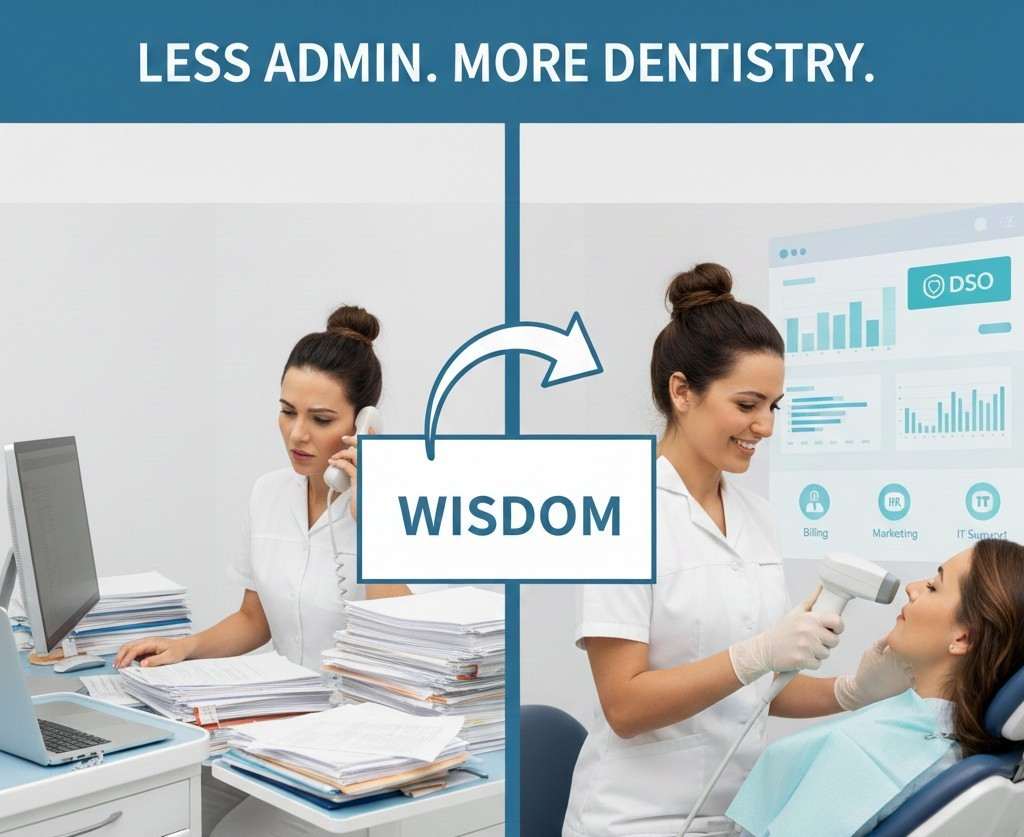
You likely became a dentist to care for and treat patients, not to chase insurance payments, manage payroll, or keep up with ever-changing regulations. But for many practice owners, those responsibilities slowly take over the workday.
That pressure is why more dentists are trying to understand what exactly a DSO is, and whether it acts as a solution or a risk.
DSOs are often misunderstood. Some dentists assume they are just corporate dentistry in disguise. Others worry that partnering with one means giving up control over clinical decisions.
In reality, DSOs come in many forms, and their role is more limited and more strategic than most people realize.
At its core, a DSO is a business partner that handles non-clinical operations so dentists can focus on patient care.
What Does DSO Stand For?
DSO stands for Dental Support Organization.
You may also hear the term Dental Service Organization, which is used interchangeably.
Both describe the same business structure: a separate company that provides non-clinical management and operational support to dental practices.
The word “support” is increasingly preferred because it reflects the intended role of the organization. A DSO supports the business side of dentistry so dentists can focus on patient care.
The rise of DSOs mirrors broader healthcare trends. As regulations increase, reimbursement pressure grows, and operating costs rise, independent dentists often struggle to manage everything alone. DSOs aggregate resources, systems, and expertise to reduce that burden.
What Is a DSO in Dentistry?
A DSO in dentistry is a company that manages the non-clinical aspects of a dental practice.
This includes administrative, operational, and business functions such as dental billing, HR, marketing, compliance, and procurement.
One distinction is critical:
DSOs do not practice dentistry.
In most states, laws known as the Corporate Practice of Dentistry doctrine prohibit non-dentists from owning or controlling clinical dental care. To comply, the DSO model separates business operations from clinical decision-making.
In a typical structure:
- The dentist owns the professional corporation and controls all clinical care
- The DSO owns or manages non-clinical assets such as equipment, real estate, technology, and administrative staff
- A contract called a Business Services Agreement defines the relationship
According to the American Dental Association, DSOs vary widely. Some are private equity-backed with hundreds of locations. Others are regional or dentist-founded organizations focused on collaboration rather than scale.
This diversity means that experiences with DSOs can differ dramatically.
How Do Dental DSOs Work?
Dental DSOs operate through a Business Services Agreement (BSA). This contract outlines what services the DSO provides, how it is compensated, and what authority it has.
There is no single DSO model. Instead, most fall into one of three structures.
1. Administrative Support Model
In this model, the dentist keeps full ownership of the practice.
As mentioned above, the DSO functions like a specialized management partner, providing selected services such as:
- Billing and collections
- IT support
- HR administration
- Marketing
Fees are usually flat or service-based. This option offers maximum independence and is ideal for established practices that want relief from specific administrative tasks.
2. Partnership or Equity Model
Here, the DSO purchases a portion of the non-clinical assets while the dentist retains control of the clinical entity.
The dentist often keeps equity in the broader organization, aligning incentives for growth and profitability.
This model is common among dentists who want capital to expand, open new locations, or acquire other practices.
It is often referred to as a Dental Partnership Organization or DPO.
3. Acquisition Model
This model is common for dentists planning retirement or seeking a full exit from management responsibilities.
The DSO acquires the non-clinical assets, and the dentist transitions into an associate or employee role. Compensation may be salary-based or production-based.
The benefit is liquidity and simplicity. The dentist monetizes years of equity while continuing to practice without administrative stress.
Across all models, the principle remains the same:
- The DSO manages the business
- The dentist manages patient care
What Services Do Dental Support Organizations Provide?
One of the biggest advantages of DSOs is scale. By supporting multiple practices, they achieve efficiencies that independent offices cannot.
Common DSO services include:
Revenue Cycle Management
Centralized billing teams handle dental insurance verification, claims submission, denial management, and aging reports. This reduces lost revenue from errors and delayed follow-ups.
Human Resources
DSOs manage hiring, onboarding, payroll, benefits, and labor law compliance, reducing risk and improving staff retention.
Marketing and Patient Acquisition
Dedicated teams manage websites, SEO, paid ads, reputation management, and analytics to drive predictable new patient flow.
Compliance and Legal Support
DSOs oversee HIPAA, OSHA, and state regulatory compliance, reducing legal exposure for practice owners.
Technology and Equipment
Many DSOs fund or negotiate favorable terms for advanced equipment, software, and digital systems.
Continuing Education and Mentorship
Clinical training, leadership development, and mentorship programs help dentists expand skills and career opportunities.
Payer Contract Negotiation
Large DSOs negotiate better insurance fee schedules due to their scale, improving profitability for participating practices.
How Can DSOs Improve a Practice’s Financial Performance?
DSOs help practices maximize revenue while reducing operational costs. Key strategies include:
- Revenue Cycle Management: Centralized billing, insurance claims, denial appeals, and aging account follow-ups increase collections and reduce lost revenue.
- Group Purchasing Power: DSOs negotiate discounts on dental supplies and technology, lowering operating costs for each office.
- Insurance Fee Negotiation: DSOs leverage size to secure better reimbursement rates from payers, improving profitability for procedures.
- Financial Reporting: Dashboards and analytics provide clear insight into revenue trends, patient payments, and key performance indicators, enabling smarter business decisions.
By handling these non-clinical financial tasks, DSOs allow dentists to focus on patient care while improving the overall financial health of the practice.
Accurate dental bookkeeping is a core part of this process, giving dentists clear visibility into cash flow, expenses, and profitability, especially when supported by structured systems like those outlined in our article, Dental Bookkeeping: The Complete Guide for Modern Dental Practices.
Do DSOs Affect Clinical Autonomy?
This is the most common concern when discussing DSO meaning and impact.
Legally, a DSO cannot control clinical decisions. Dentists retain full authority over diagnosis, treatment planning, and patient care.
However, indirect influence can exist. For example:
- Preferred vendors may be required
- Labs may be standardized
- Scheduling templates may be optimized for efficiency
A strong Business Services Agreement clearly protects clinical independence.
Dentists should review:
- Who controls clinical leadership
- Whether material and supply choices meet quality standards
- How performance metrics are defined
The best DSOs balance financial health with quality care and long-term sustainability.
How Is a Dental DSO Different From Corporate Dentistry?
“Corporate dentistry” is an informal term often used to describe large, multi-location dental groups.
A DSO is the actual legal and operational entity behind those groups.
In most states, corporations cannot own clinical dental practices. What appears to be corporate dentistry is actually multiple dentist-owned practices supported by the same DSO.
Not all DSOs feel corporate. Many are dentist-led, regionally focused, and culture-driven. Evaluating leadership, incentives, and values matters more than labels.
Who Should Consider Partnering With a DSO?
New Graduates
DSO-supported practices offer stable income, mentorship, benefits, and reduced financial risk compared to immediate ownership.
Mid-Career Dentists
DSOs help dentists escape administrative overload, access capital, and scale without managing everything themselves.
Dentists Nearing Retirement
Selling to a DSO provides liquidity, continuity of care for patients, and a gradual transition out of practice ownership.
How Do Dentists Choose the Right DSO for Their Practice?
Choosing the right DSO is critical for maintaining independence, financial health, and clinical quality. Dentists should consider:
- Clinical Autonomy: Ensure the DSO’s contract clearly protects your authority over treatment decisions and patient care.
- Service Scope: Verify which administrative, marketing, HR, and technology services are included, and whether they match your practice needs.
- Financial Structure: Understand fees, equity arrangements, and any production-based incentives that could affect revenue or workload.
- Culture and Support: Evaluate leadership style, office culture, mentorship programs, and growth opportunities to ensure a good fit.
- Exit Options: Check the contract for flexibility, notice periods, and non-compete clauses to avoid future limitations on your practice.
Asking these questions and performing due diligence helps dentists select a DSO that aligns with their goals, reduces administrative burden, and supports long-term growth.
What Are Current DSO Trends in the US?
DSOs are growing quickly in the United States, and several trends are shaping the industry:
- More Practices Joining DSOs: About 1 in 5 dental offices now work with a DSO, especially newer dentists and specialty practices.
- Private Equity Involvement: Big DSOs often have investors, helping them expand and provide more resources to affiliated practices.
- Better Technology: DSOs bring digital tools like modern practice management software, teledentistry, and automated billing.
- Specialty Growth: DSOs are supporting more specialties, such as orthodontics, oral surgery, and endodontics.
- Mentorship and Training: Many DSOs offer structured guidance and continuing education for dentists.
Knowing these trends helps dentists see how DSOs can support growth, efficiency, and career development.

How Wisdom Helps Without Taking Ownership
If you want many of the operational benefits DSOs offer without giving up equity or independence, Wisdom can help.
Wisdom is a dental revenue cycle management partner focused on optimizing your practice’s billing and financial processes. Our dental billing team works with your existing systems to optimize revenue flow while you stay in full control of your practice.
Here’s what Wisdom specializes in:
Insurance Claim Processing
Wisdom submits primary and secondary claims accurately and on time to accelerate reimbursements.
Payment Posting
We post insurance payments promptly, track EFTs with detailed reports, and manage accurate write-offs.
Claims Follow-up and Aging Management
Wisdom actively monitors overdue insurance claims, follows up every 14 to 21 days, and appeals denied services to recover revenue that might otherwise be lost.
Dental Insurance Verification
Our team provides dental insurance verification, detailed eligibility checks, and coverage breakdowns so your office can plan treatment with confidence and avoid surprises.
Patient Billing and Collections
Wisdom manages dental patient billing and overdue patient balances with customized statements, letters, and follow-up calls, helping keep patient accounts current while respecting patient relationships.
Practice Reporting and Insights
Through regular reporting, Wisdom gives visibility into key financial metrics so you can make informed decisions faster.
You keep your practice name, brand, clinical autonomy, and team. Wisdom simply focuses on capturing revenue accurately and efficiently so you collect more of what you already earn, reduce administrative burden, and improve cash flow - all without selling or relinquishing ownership.