
If you’ve looked for help with dental billing lately, you’ve probably noticed that the options have changed.
For years, most practices had two choices: hire someone internally or outsource the work. Today, AI-powered tools have added another option, promising to automate parts of the revenue cycle that once required hours of staff time.
That has created more choice for practices, but also more to compare. Some solutions add more hands, some automate a specific task, and others take responsibility for more of the revenue cycle.
So how do you know what actually makes sense for your practice?
Dental professionals want AI. They also want someone accountable.
We recently asked dental professionals which model they believe is most effective for insurance verification and billing.
The results were telling:
- Only 1.6% selected fully autonomous AI with no human review.
- 37.7% preferred in-house staff using AI tools.
- 31.7% preferred AI paired with human billing experts.
- 15.1% preferred billing to remain entirely human.
Taken together, nearly 70% chose a model where people remain responsible for the work while AI helps make the process more efficient.
Dental professionals want technology to make billing easier, but they still want someone responsible when the work gets complicated.
That distinction is worth keeping in mind as you compare the different billing models available today.
1. Keeping billing in-house gives you control, but also all the responsibility
For many practices, hiring an internal biller still feels like the most familiar option. The right biller will know your practice inside and out, from the patients coming through the office to all the quirks of your systems. When someone has a question, there’s a person right there who understands the context.
The tradeoff is that the practice also becomes responsible for supporting the entire billing function.
Beyond salary, there are:
- Benefits
- Training
- Management
- Software
- Turnover
- Coverage when someone takes vacation or gets sick.
If your billing operation depends heavily on one experienced employee, losing that person can create a significant gap very quickly.
What to watch for
An in-house model can work extremely well for practices with the right people and the resources to support them. But if you’re considering another hire because your existing team already has too much on their plate, it’s worth asking whether you really need another person to manage or whether you need more of the billing work taken off the practice altogether.
2. AI-first solutions can automate a task, but the harder work may still belong to you
AI-powered billing tools can be particularly effective at repetitive, high-volume work.
Payment posting is a great example: technology can retrieve payment information, apply predefined rules, and move that information into supported practice management systems much faster than someone could enter every transaction manually.
That can save a meaningful amount of time, but the important question is what happens outside that automated workflow.
What to watch for
- A payment may be posted, but someone might still need to determine whether the amount was correct
- An exception may be flagged, but someone needs to decide what to do about it
- A denial can appear in the system, but recovering the money may require documentation, payer calls, an appeal, and another round of follow-up
- A secondary claim may go out automatically, but someone still needs to make sure the primary EOB is attached and the amounts line up
All that work still needs an owner, and while a point solution can automate one part of the process, the practice remains responsible for what happens before, after, and between those steps.
This is where point solutions like Lassie are worth evaluating carefully. Lassie focuses heavily on automating payment posting and related workflows, which can be useful when posting is the specific bottleneck your team is trying to solve. But that narrower scope also means your practice still needs a plan for the work happening around it, including claims, denials, aging, verification, exceptions, and follow-up.
If your team still needs to review questionable payments, investigate exceptions, handle denials, work aging, and decide what happens next, you may have automated the straightforward part while keeping the complicated work in-house.
Before choosing an AI-first solution, make sure you understand where the technology’s responsibility ends and your team’s begins.
3. Full-cycle billing support takes on more of the revenue cycle
Outsourcing can take a meaningful amount of work off a practice’s plate because the responsibility moves to a dedicated billing team rather than staying with internal staff.
The experience can vary quite a bit, though. Some billing companies still rely heavily on manual processes, offer limited visibility, or only cover certain parts of the revenue cycle. A practice may get help with claims and aging, for example, but still handle verification, posting, patient balances, or other follow-up internally.
That’s why the better research to do is finding out what the outsourced partner is actually taking responsibility for, and how well they are equipped to do it.
What to watch for
A modern billing partner should bring both expertise and technology to the work. Technology can speed up repetitive tasks, organize information, and surface issues sooner, while experienced billing professionals can focus on the parts that require judgment, investigation, communication, and persistence.
That’s the model Wisdom was built around.
Wisdom supports practices across insurance verification, claims submission and follow-up, payment posting, denials and appeals, underpayment investigation, patient billing, and aged AR.
That broader scope becomes especially valuable when something doesn’t go according to plan.
- If an account needs research, someone researches it
- If a denial should be appealed, someone works the appeal
- If a payment doesn’t make sense, someone investigates why.
- If additional follow-up is needed, the next step doesn’t automatically fall back onto the front desk.
With Wisdom, more of the work gets done and moves under one cohesive and accountable team. Technology helps speed up the busy work, but the real value comes from what that speed allows the team to do with it.
When claims go out faster, they can get paid faster. When an issue shows up, there’s already someone there to investigate it. And when a claim needs more follow-up, your office doesn’t have to figure out who has time to pick it back up.
Your practice spends less time managing the billing process and more time trusting that it’s being handled.
Where the differences really start to matter
Most billing models can look good when everything goes according to plan, but the differences start to show the moment something requires a second look.
Insurance verification: Getting the information is only the beginning
Insurance verification has historically been one of the most time-consuming jobs in the front office, so it makes sense that practices are excited about automation.
Technology can retrieve a tremendous amount of benefit information quickly, which gives a trained specialist a much better starting point than spending hours working through payer portals and phone trees.
But dental benefits are rarely as simple as a single eligibility response.
Frequency limitations, downgrade provisions, waiting periods, missing-tooth clauses, treatment history, plan exclusions, and other payer-specific requirements can materially change what will happen when the claim is submitted.
Those details affect insurance coverage, as well as treatment estimates, scheduling, patient conversations, and ultimately collections.
Wisdom uses technology to accelerate the process while keeping experienced verification specialists involved in reviewing and interpreting the details that matter. The goal is to give the practice useful information that it can confidently act on rather than simply delivering data as quickly as possible.
Payment posting: A posted payment still needs context
Payment posting is probably where the distinction between automation and revenue-cycle management is easiest to see.
The repetitive parts of posting are ideal candidates for technology, especially when automation frees a trained billing professional to focus on the parts that require judgment.
But posting also serves an important financial-control function.
When a payment arrives, there are questions worth asking:
- Was the contractual adjustment appropriate?
- Was the procedure downgraded?
- Does the remaining balance belong to the patient?
- Did the payer process the claim correctly?
- Does anything need additional follow-up?
When the goal is to move the transaction into the PMS as quickly as possible, it can be easy to miss some of those questions. That can mean rework down the line or, more importantly, revenue that never gets a second look.
At Wisdom, payment posting is part of the larger billing process. Our team reviews what happened, reconciles the account, and leaves the practice with the context it needs to understand the balance and determine what comes next.
That level of context and human attention can make a real difference when a patient has a question, a claim was underpaid, or an account that looks finished still has money worth pursuing.
A completed task is not always a resolved account.
Aged AR: Finding the money and recovering it are different jobs
Technology can make aged AR dramatically easier to understand because it can organize balances, prioritize accounts, surface trends, and show a practice exactly where money is sitting.
That visibility is valuable. But recovering the money usually requires something more hands-on from an experienced billing professional.
For example, someone may need to investigate the claim history, review notes, call the payer, correct an error, send documentation, appeal a denial, escalate the issue, and come back to the account again if the first attempt doesn’t resolve it.
While it’s good for a practice to be aware that they have $40,000 in aging, it’s even better when there is someone patiently working through that pile, determining what can still be collected, and actually doing something about it.
AI-first payment posting vs. full-cycle billing support
AI-first tools and full-cycle billing partners both use technology to make dental billing more efficient, but they solve very different problems.
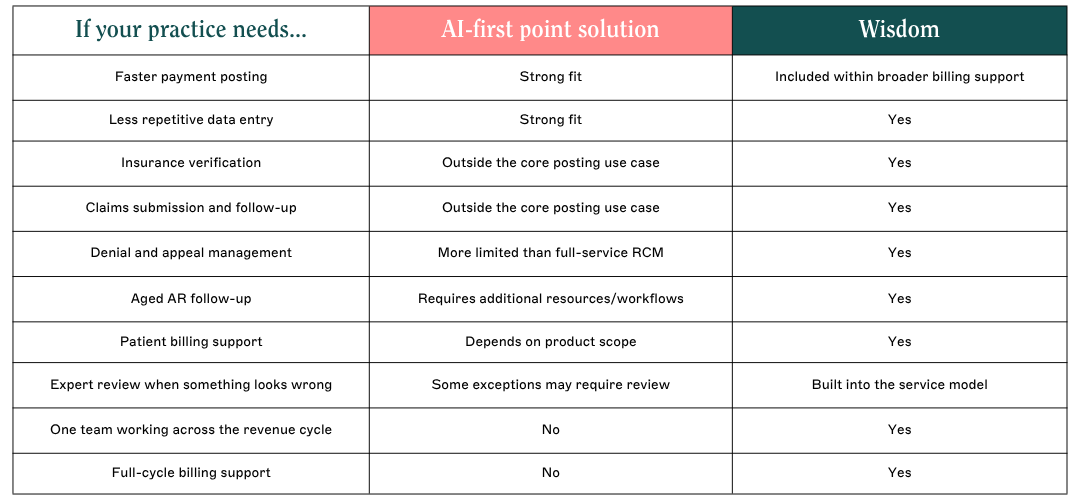
The right choice depends on the problem you’re trying to solve.
If your revenue cycle is already healthy, your team has strong billing expertise, and payment posting is the primary source of administrative burden, a focused automation tool may solve that specific problem.
But if your team is already spending time across verification, claims, denials, aging, posting, and patient balances, solving one of those problems may not change the larger workload very much.
Before you choose, ask what will still belong to your team
There’s no single right way to get help with dental billing, and every solution presented in this article can take some amount of work off your team’s plate.
The bigger difference is how much responsibility stays behind.
When you’re looking for the right fit for your practice, ask yourself how much of the work you want to keep in your practice once you bring that help in.
Before signing on with a new partner, here are some questions to ask:
- Who reviews the account when something doesn’t match expectations?
- Who contacts the payer?
- Who manages denials?
- Who determines whether the balance should be adjusted or pursued?
- Who follows the account again next week if the issue hasn’t been resolved?
- After we implement this solution, what billing work will my team still be responsible for?
A tool that saves ten hours of data entry can be incredibly helpful. But if your team still owns the denials, exceptions, aging, follow-up, and patient questions, you may still be carrying more of the billing burden than you expected.
Take the extra beat to understand the difference before you commit.
Technology should make billing easier. Expertise should make it work.
AI has an important role in the future of dental billing, and Wisdom uses technology every day to make the work faster and more efficient.
But speed only gets you so far in this industry.
When a payment looks wrong, a denial needs to be appealed, or money starts sitting in aging, someone still needs to understand what happened and keep the account moving.
That’s why Wisdom combines technology with experienced billing professionals across the full revenue cycle. Our goal is to take more of the work off your plate while keeping someone accountable for moving revenue forward, so your team isn’t left managing the exceptions or figuring out what happens next.
A focused point solution may be enough for a practice that only needs help with one specific task.
But if your goal is to get more of the billing work off your team’s plate and have one partner responsible for keeping revenue moving, a full-cycle model offers something very different.
Posting is one task. Billing is the whole job.
Whatever solution you choose, choose something that gives your practice the help you actually need. You deserve the peace of mind that comes with knowing that someone is watching the details, following the money, and helping you collect every dollar you worked hard to earn.
If you’re not sure where your practice needs the most support, start with your numbers. A complimentary practice analysis with Wisdom can help uncover where revenue is getting stuck, where your team is spending time, and which parts of your revenue cycle need the most attention.
See where revenue may be getting stuck and where Wisdom can help take the work off your team’s plate.