.png)
Why HIPAA Isn’t Optional in Dental Billing
When your dental billing company touches patient information, you’re trusting them with more than your revenue—you’re trusting them with your reputation.
Every claim submission, EOB review, and insurance call involves Protected Health Information (PHI)—and under HIPAA, that makes your billing company a Business Associate (BA).
That means your billing company is held to the same federal privacy and security standards as your dental practice.
The right billing partner doesn’t just understand CDT codes and claim follow-up—they understand data protection, secure communication, and the legal responsibility that comes with handling PHI.
This guide explains what you should expect from your billing company when it comes to HIPAA compliance, and how to make sure your patient data stays safe while your collections stay strong.
The Billing Company’s Role in HIPAA Compliance
Under HIPAA, your dental practice is the Covered Entity (CE), and your billing company is your Business Associate (BA).
That relationship triggers specific legal obligations, including:
- Signing a Business Associate Agreement (BAA) before PHI is shared
- Implementing administrative, technical, and physical safeguards to protect PHI
- Reporting any security incidents or data breaches promptly
- Ensuring subcontractors (like remote team members or third-party platforms) are also compliant
If your billing company doesn’t have a signed BAA with you, your practice is technically out of compliance—no matter how good they are at claims.
What a HIPAA-Compliant Dental Billing Partner Looks Like
Here’s what to expect from a billing company that takes HIPAA seriously:
1. A Signed Business Associate Agreement (BAA)
The BAA should outline:
- Responsibilities for data protection
- How and when the billing company reports potential breaches
- Whether subcontractors (like remote workers or off-site support) are covered under the same terms
If your billing company says, “We don’t need a BAA,” stop right there. That’s a dealbreaker.
2. Secure Communication Channels
HIPAA prohibits sending PHI over unencrypted email or text. A compliant billing company will:
- Use encrypted email or secure portals for claim attachments and patient info
- Avoid consumer apps like Gmail, Dropbox, or Slack (without BAAs)
- Have a documented data retention and disposal policy for shared files
3. Employee HIPAA Training
Every team member who touches PHI—whether in-office, remote, or offshore—should receive annual HIPAA and data privacy training.
Ask your billing partner: “Do you train your staff on HIPAA and security every year, and do you document it?”
If they can’t answer confidently, assume they aren’t.
4. Access Controls and Authentication
Each user should have a unique login for your practice management software, cloud platforms, or billing system—no shared accounts or “billing team” passwords.
They should also use:
- Multi-Factor Authentication (MFA)
- Session timeouts for remote systems
- Audit logs showing who accessed which patient records and when
5. Secure Remote Work Protocols
Many billing companies use remote or hybrid teams—nothing wrong with that if it’s done securely.
A compliant company ensures:
- Encrypted connections (VPN or remote desktop)
- No patient data stored locally on personal devices
- Screen privacy, workstation locking, and restricted data exports
Common HIPAA Pitfalls in Dental Billing (and How to Avoid Them)
Pitfall 1: Sending PHI over unencrypted email
If your billing partner sends attachments like EOBs or x-rays over standard email, that’s a
violation.
Better option: Encrypted email or secure file transfer portals
Pitfall 2: Using third-party tools without a BAA
Popular tools like Trello, Asana, or Google Sheets can expose PHI if not under a signed BAA.
Better option: Use HIPAA-secure task management or spreadsheets under a compliant business
license. At Wisdom, we send documents through our secured Google document storage for
convenience and security.
Pitfall 3: Lack of audit trail
If you can’t tell who accessed a claim or attachment, you can’t prove compliance.
Better option: Require your billing team to log activity through your PMS or secure CRM.
Pitfall 4: Data saved on personal devices
Remote billers saving spreadsheets or EOBs on their laptops is a recipe for a breach.
Better option: Virtual desktops or encrypted cloud-based systems where data never leaves the secure environment.
Technology Checklist for HIPAA-Secure Billing Operations*
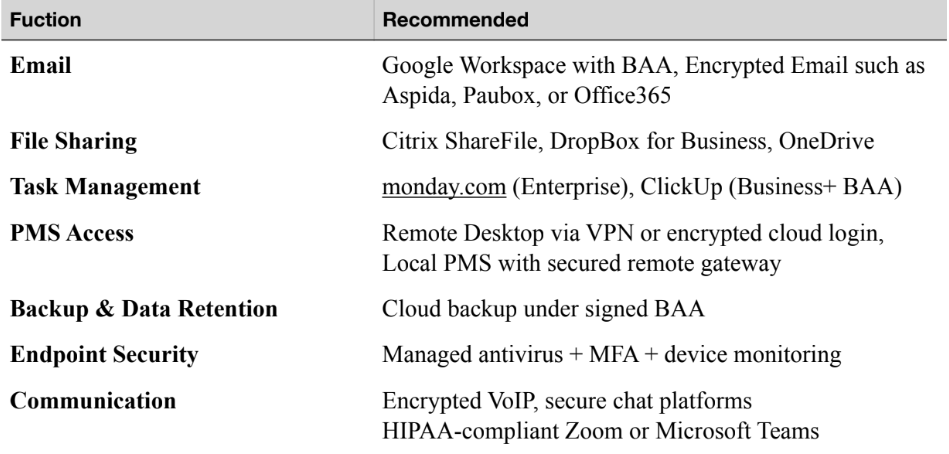
*This is not a comprehensive list of compliant solutions, but rather a suggestion of options available within the enterprise space.
Shared Responsibility: Practice + Billing Partner
HIPAA compliance isn’t one-sided—it’s a team effort.
.png)
When both sides do their part, compliance becomes automatic—and data stays protected at every step of the revenue cycle.
Questions to Ask Your Billing Company
1. Do you sign a Business Associate Agreement (BAA)?
2. How do you encrypt PHI in emails, backups, and stored files?
3. Do your employees receive annual HIPAA and cybersecurity training?
4. How do you secure remote access to our systems?
5. Do you maintain an audit log of PHI access?
6. What’s your process for reporting a data breach?
7. Are your subcontractors or offshore staff bound by HIPAA under your BAA?
8. How long do you retain PHI before securely deleting it?
9. Are your team members US based?
10. Do you maintain Cyber liability Insurance?
What We Do at Wisdom
At Wisdom, we know that compliance is as important as collections. That’s why our systems are designed to protect your patients’ data every step of the way.
We:
- Sign and maintain a Business Associate Agreement with every client
- Use encrypted systems for communication and file transfer
- Train all employees annually on HIPAA and data security
- Enforce multi-factor authentication and remote access controls
- Conduct internal audits to ensure ongoing compliance
When you partner with us, you get more than a billing team—you get a compliance-conscious
extension of your practice.
The Takeaway: Revenue and Compliance Go Hand in Hand
A great billing company doesn’t just get claims paid—they protect your patients, your practice, and your peace of mind.
HIPAA compliance is not a checkbox. It’s the foundation of trust that allows you to grow your practice confidently.
With the right billing partner, you’ll have both: Strong revenue performance and secure, compliant processes
Because in modern dentistry, compliance is good business.