

Dental billing for small practices comes with a unique problem: there’s often too much work to squeeze into the day, but not enough claim volume to justify a full-time billing team. That leaves solo practitioners and small dental offices trying to manage insurance verification, claims, denials, payment posting, and patient collections alongside everything else it takes to run the practice.
Most small practices that sit down with Wisdom have no idea they're losing money. They’re doing great dentistry and have a packed schedule, and yet, revenue is slipping through the cracks every month.
It’s not because anyone is careless. In fact, most offices spend all day focused on patients, and that focus is exactly why the bigger picture gets away from them.
Here are the six challenges we see most often in solo and small practices, what they actually cost, and what to do about each one.
1. Wearing Too Many Hats
In a large dental practice, the many roles that keep the practice running belong to several different people. Verification, claim submission, denial appeals, posting, and patient collections will each belong to a different owner. In a solo practice, however, all tasks belong to one person who is also answering the phone, confirming tomorrow's schedule, checking patients in and out, ordering supplies, and more.
Anyone who has worked admin at a smaller office is familiar with skipping lunch and bathroom breaks to put out fires from open to close. Billing, however, is the fire nobody sees. It's the only task with no patient standing in front of you, so it fits into the day if you have time. A patient at the desk will prioritize a call on hold with insurance every single time, and honestly, it should!
That's the whole problem in one sentence.
The problem often manifests and hides in your collection percentage, the number that tells an office whether it got paid for the work it provided. At Wisdom, the benchmark we aim for is 98% or higher. In small offices, where billing is a part-time job stacked on top of a full-time one, we see collection percentage routinely land in the 80s. That means that those offices are only collecting 80 to 89 cents of every dollar they produce.
Here's a real example from a Wisdom practice analysis we ran for a small office, looking at one month:
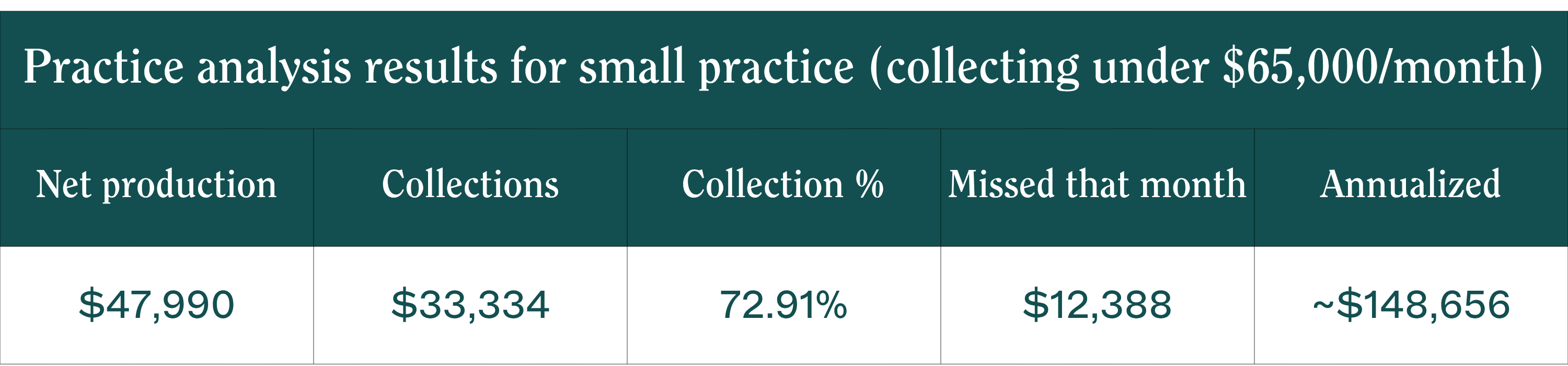
Nothing was wrong with this practice's dentistry. The patients showed up, the doctor did the work, and the care was good. That $12,388 in the missed revenue column was money the practice already earned for completed treatment. But due to limited capacity and leaky systems, that’s thousands of dollars that were never collected.
Now stretch that over a year. That's close to $149,000 walking out the door.
The hardest part is that nobody in that office knew because they were surviving each day with endless tasks. The schedule was full and it felt like a good month, but hiding under the surface was a much larger problem.
What helps: start by finding out where the practice really stands. A free Wisdom practice analysis uses one month of the office's numbers to show its true collection percentage and exactly where the money is slipping. From there, billing needs to be treated as a role instead of a task squeezed into the day. That often means a dedicated person or a partner like Wisdom.
2. Too Many Hands in the Pot
The first challenge is one person carrying everything. The second is its opposite, and it's just as expensive.
In most small practices, billing was never assigned. It got divided by circumstance:
- Whoever checks the patient out posts the payment
- Whoever picks up the phone takes the insurance carrier call.
- The doctor adjusts a balance chairside to be kind.
- One team member sends statements when the schedule allows.
- Another resubmits a claim without knowing the first one was already appealed.
Although everyone is touching the process at one point or another, there is no clear owner.
A revenue cycle with no owner fails in the gaps: the claim everybody assumed someone else worked, the denial that got closed instead of appealed, the balance written off by a person who had no idea it was a covered benefit worth fighting for.
Three things go wrong almost every time:
- Nobody owns the aging report. If no single person is responsible for reading it monthly, follow-up has no cadence, because it isn't on anyone's calendar.
- The claim history lives in people's heads. Two team members call the same carrier about the same claim in the same week and neither knows what the other was told. Detailed notes on every claim, who you spoke to, what they needed, how you sent it, when they expect to pay, and a reference number, are what make the work transferable. Living in your head is not good enough.
- Adjustments get made by several people with no notes. It's easy to miss, and once someone does notice, it's nearly impossible to figure out why each adjustment was made. When four people have permission to write off a balance and nobody documents why, the practice loses track of where that money went. (More on why that matters in challenge 6).
Turnover is what makes all of this compound. In struggling offices, the billing position becomes a revolving door of hiring, training, and retraining, and every time it turns over the process starts over from scratch due to a lack of clear systems and documentation.
When a new teammate is hired, they are usually trained by whoever is still there, on what that person thinks they know.
So whatever the last person misunderstood gets taught forward as fact. Do that three or four times and the office is running on a version of the workflow nobody ever actually designed, and no one left can tell you why it's done that way because the habits that never got corrected become "how we've always done it."
Every time the billing position turns over, the practice pays twice. First to train someone new, then to undo what the last person got wrong.
What helps: assign one owner per system, not per task:
- One person owns insurance aging and follow-up.
- One owns patient statements and collections.
- One approves adjustments, ideally the doctor.
Other people can still do the work, but a system without an owner gets assumed instead of reviewed. When Wisdom partners with a practice, we take ownership of the billing so nothing falls through the gaps between people.
If you’re keeping billing in house, then write the process down, even roughly. A one-page workflow for claims, statements, and adjustments is what turns training into onboarding instead of oral history. It's also the only thing that survives turnover.
3. Limited Bandwidth for Denial Follow-Up
Submitting a claim is technically the easy part, while denials are where things can get really tricky.
This challenge shows up in insurance A/R aging, and there are two buckets to watch here:
- Current, 0 to 30 days: At Wisdom, we want 70 to 75% or more of your aging sitting here. This bucket tells you whether claims are actually going out on time. A thin current bucket is a submission problem, not a payment problem.
- Over 90 days: At Wisdom, we want 5% or below. Above that, you're looking at denials that were never appealed, rejections that were never corrected, or no follow-up rhythm at all.
Collectability drops meaningfully once a claim passes 60 days and drops again past 90. Insurance companies are essentially counting on you to forget, betting (often correctly) that you don't have the team or the hours to chase it.
Rejections, a claim that never even reaches the carrier, often hurts the most because it usually stalls over something small like a member ID or a demographic “mismatch." It can sit at least 30 days before it even appears on your aging report. Nobody denied it. Nobody paid for it. It's just gone unless someone is watching the clearinghouse.
The second place this shows up is your collections split. For an in-network practice, expect roughly 50/50 between insurance and patient collections. In a recent Wisdom practice analysis, one office's split was 21.93% insurance and 78.07% patient. That practice wasn't collecting from patients unusually well, but instead, it was leaning on patients because the claims weren't paying. When that happens, patients end up paying for what their insurance should have covered. That’s how trust at the front desk starts to wear down.
This is the kind of thing a practice analysis catches. The office pulls one month of reports and we run the numbers. Then we sit down together and walk through what we found to paint a clear picture of where the money is going, judgement free.
What helps: follow up on outstanding claims every 14 to 21 days, and put detailed notes on every one: who you spoke to, what they needed, how you sent it, when they say they'll pay, and the reference number. Living in your head is not good enough, and it definitely isn't good enough when you're out sick. If a denial is for a covered benefit, appeal it, and not just once.
4. One Hero Away From Chaos
Nearly every small practice has someone holding it all together. For example, my sister and I grew up working in our dad’s dental practice. When she left to stay home and raise her kids, my dad and I felt her absence deeply. So much of what kept the office running had lived with her as our billing hero, and suddenly it was on the rest of us to pick up the pieces.
I was the hygienist, and I'd finish a patient and jump on the phone to call on a claim. I wrote appeals in the minutes before my next patient sat down. I helped train whenever I could squeeze it in. The rest of the team was doing the same thing, juggling billing on top of everything else. Some days I came in when the office was closed just to try to catch up.
And despite all that, we were still drowning.
When collections depend on one person instead of a system, there's no real revenue cycle. When that person leaves, everyone left behind feels it. Looking back, I can see the cracks clearly:
- The month rose and fell with our schedules. Once my sister was gone, billing got done in whatever time we could find. If we had a lighter day, claims got worked. If the schedule was packed, they sat. Nothing about the process changed, only our bandwidth.
- Nobody could see the work, so nobody could check it. My sister’s systems were written down, but there was nobody to keep that accountability. Everyone was handling pieces, and there was nothing to compare against. If a claim slipped or a denial got closed instead of appealed, no one was in a position to notice.
- We only knew what we'd been taught. Every new team member learned from whoever was there before them. If that person had holes in their training, the new person inherited them too. Quickly my sister’s systems got changed. Mistakes got passed down as "how we do it," and nobody knew any different. On top of that, carriers kept changing rules, and nobody in the office had time to track them.
- Turnover kept resetting us. Every time someone left, we lost what they knew and started training all over again. Whatever gaps were already there got handed to the next person, and we never had the chance to get ahead.
- Hard work hid the broken system. We covered the gaps by staying late and coming in on days the office was closed.We kept patching things, but nobody stopped to fix the workflow itself. The problems only became visible when we couldn't keep up anymore.
- Nobody could take a real break. When the system depends on people pushing through, burnout is a matter of when, not if. In a small office, the team's burnout and the practice's cash flow end up being the same problem.
Having a strong biller is a great asset, but only when the whole practice is set up on strong and reliable systems. Systems are what make a good biller effective instead of indispensable, and they're also what tell a great biller when the rules have changed.
What helps: put the numbers in front of the doctor monthly, not as a check on anyone, but so the practice's financial health isn't a single person's report card. Four numbers is enough: collection percentage, adjustment percentage, insurance A/R over 90, patient A/R over 90. Those four don't require billing expertise to read, which is the point. They give a doctor a way to ask a real question without needing to audit anyone.
Then get outside eyes on the work periodically. Not because anyone is failing, but because a practice that only ever sees its own way of doing things has no way to know what it's missing. Bring the whole team into reviewing stuck claims, clinical included, since getting claims paid is genuinely teamwork. And make sure the process exists somewhere other than in the memory of one team member, so the expertise is something the practice keeps rather than something it borrows. If you need help, check out our DIY self audit guide
5. No Backup When Staff Are Out
The real test comes the day your billing person isn't there. That's when you realize how much of the office depends on them showing up. And finding someone who knows your system well enough to step in is nearly impossible.
So the work just stops: claims don’t go out, denials sit untouched, and patient statements never get mailed.
Whoever is left or whoever is hired in an emergency is just trying to survive the day. They’re checking patients in and answering calls, while trying to figure out a clearinghouse they’ve never logged into. Nobody wrote down the process, so they’re learning on the fly with no one to ask.
That’s learning by fire and the first place it shows up is usually in the denials. They pile up because nobody knows how to work them, or even where to find them. The longer a denial sits, the fewer good choices an office is left with. In the end, there are three options:
- Fight it with the insurance carrier until they pay
- Write it off
- Push it to the patient
The first option is the only outcome where the doctor gets paid. Write-offs might feel like good customer service, but in reality, they're bad business. Moving the balance to the patient has its own problems. Teams understandably want to avoid that conflict, so the balance sits.
And the longer it sits, the harder it gets. At Wisdom, we want patient A/R over 90 days at 10% or below. We’ve seen it firsthand: the older a balance gets, the less likely a patient is to pay it. After a few months, they've forgotten the visit and the explanation they were given. They start to wonder if the bill is even right.
Most offices we talk to have no idea what their own percentage is. Nobody has time to pull it, so it's one of the first things we look at when we sit down with a practice for a practice analysis.
In that analysis I mentioned earlier, the practice's patient A/R over 90 days was 76.16%. Simply put, most of what patients owed had gone unpaid for more than 90 days. Nobody in the office had any idea. They were too busy taking care of patients to see it piling up.
What helps: cross-train a second person on the basics, and make sure whoever covers has documented access to clearinghouse logins, carrier portals, and fee schedules. Coverage that depends on one person's memory isn't coverage. Send statements on a set cadence, every 30 days, with letters and calls layered in. And keep your payment table updated as EOBs get posted, because accurate estimates are what stop new patient balances from forming in the first place. Patients generally don't mind paying. They mind surprises.
6. Finding a Billing Partner That Doesn't Require Enterprise Volume
The final challenge is the market itself.
A solo practice doesn't submit enough claims to justify a dedicated full-time biller, but submits far too many for "whoever has a free hour." Hiring in-house means a full salary, benefits, and payroll taxes for a role that's genuinely busy maybe 20 hours a week. So most small offices look outside, call three billing companies, and hear three versions of the same answer: a monthly minimum well above what their volume justifies, a long contract, and an onboarding fee.
That leaves solo offices choosing between an incompatibly sized partner and continuing to absorb the loss quietly, not truly understanding the impact of revenue earned but never collected.
Most small practices have spent years building something special. Patients feel known when they walk in, and the front desk greets them by name. That kindness is a big part of why patients stay. So handing billing to an outside company can feel risky, because a cold or confusing patient statement can undo years of trust in a single phone call.
The right partner protects that feeling. They bring real billing expertise, but they treat your patients the way you would. When a patient calls with a question, they get patience and a clear answer instead of a runaround. That's what a small practice deserves: experts who handle the numbers with the same care you put into the chair.
I understand this one personally. My dad's practice was small, and we treated our patients like family. When our billing fell apart, protecting those relationships mattered to us as much as the money. We didn't need a big, complicated system. We needed systems that actually worked, run by people who understood a small office and cared about our patients as much as we did.
Small practices don't need an enterprise solution. They need a partner sized to fit them, one that treats their billing like it matters no matter how many claims they send. That's harder to find than it should be, which is exactly why it's worth knowing what to look for.
Why Wisdom Works for Small and Solo Practices
Wisdom was built inside a small practice. My dad was the dentist, and our family lived every challenge in this article. We were understaffed and doing too much, all while our hard earned money quietly leaked behind the scenes. My sister built the systems that pulled us out, and those same systems are what Wisdom runs on today.
That's why we understand small offices. We know a solo practice doesn't need an enterprise solution. It needs a team that treats its billing like it matters, because it does.
When you work with Wisdom, you get:
- Insurance billing, patient billing and insurance verification all done by one team of experts
- Streamlined systems that run the same every month, so results stay consistent no matter what’s happening in the office
- Verification done before the patient arrives, with history, limitations, and frequencies, not just eligibility.
- Claims go out the next business day, and line-item, procedure-by-procedure posting with correct adjustments and no over-adjusting and detailed posting notes.
- Aggressive Appeals included, not billed extra, so claims don't just get written off
- Clear reporting of your collection numbers so you always know where your practice stands
And it starts with a free practice analysis. We take one month of your real numbers and show you exactly where money is slipping. There's no pressure and no judgment. It's just a clear picture of where your practice stands.
.png)
.png)
.png)